Modern data centers require continuous power to support critical IT infrastructure. Every server, storage device, network switch, and security appliance depends on a reliable electrical supply. Even a few milliseconds of downtime can interrupt business operations, corrupt data, and impact customer services.
Many organizations ask a common question when designing a resilient power infrastructure: Should a data center rely on a UPS or a generator?
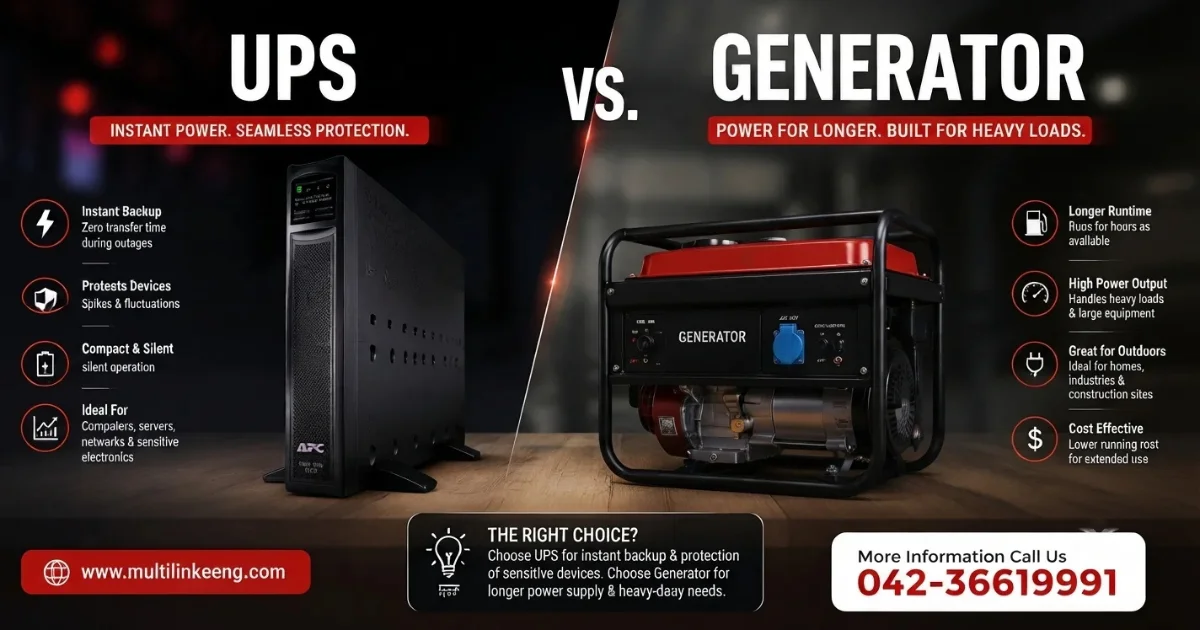
The answer is not as simple as choosing one over the other. A professionally designed data center uses both technologies because they perform different but complementary roles. A generator provides long-term backup power, while an https://www.multilinkeng.com/services/ups/“>APC UPS delivers instantaneous protection during power disturbances and generator startup.
Businesses across Lahore, Karachi, and Islamabad increasingly deploy enterprise-grade APC UPS solutions together with standby generators to achieve maximum uptime. As an Elite APC Partner in Pakistan, Multilink Engineering (multilinkeng.com) designs, installs, and maintains complete power protection solutions for mission-critical facilities.
Understanding Data Center Power Infrastructure
A data center operates 24/7. Therefore, its electrical infrastructure must handle:
- Utility power failures
- Voltage fluctuations
- Brownouts
- Blackouts
- Frequency variations
- Power surges
- Electrical noise
- Short circuits
- Equipment failures
Without proper protection, these issues can damage expensive IT equipment and cause unexpected downtime. Consequently, enterprise facilities implement layered power protection using APC UPS systems, automatic transfer switches, backup generators, intelligent PDUs, and battery management systems.
How APC UPS Systems Work
APC UPS systems continuously monitor incoming electrical power. During normal operation, they filter electrical noise, stabilize voltage, recharge batteries, supply clean power, and monitor battery health.
If utility power fails, batteries immediately power the inverter. Consequently, servers continue operating without rebooting. Once the generator becomes operational, the UPS seamlessly transfers the load without interrupting connected equipment.
Why Generators Cannot Replace UPS Systems
Many organizations mistakenly believe a generator eliminates the need for a UPS. However, this assumption creates significant operational risks. Generators cannot protect against millisecond outages, voltage dips, electrical spikes, frequency instability, short utility interruptions, harmonic distortion, and generator startup delay. Even a five-second outage can shut down servers. Therefore, data centers always require a UPS before generator power becomes available.
UPS vs. Generator: Technical Comparison
| Feature | APC UPS | Generator |
| Response Time | Instant (0 ms) | 10–30 seconds |
| Backup Source | Batteries | Diesel or Gas |
| Voltage Regulation | Excellent | Moderate |
| Frequency Stability | Excellent | Moderate |
| Power Conditioning | Yes | No |
| Runtime | Minutes to Hours | Hours to Days |
| Maintenance | Low to Moderate | Moderate to High |
| Noise Level | Very Low | High |
| Indoor Installation | Yes | Usually No |
| Fuel Requirement | No | Yes |
| Environmental Impact | Low | Higher |
| Critical Equipment Protection | Excellent | Limited |
This comparison clearly demonstrates that both systems serve different purposes.
Why APC UPS Is Essential for Data Centers
Enterprise APC UPS systems provide much more than battery backup. They deliver:
Instant Power Continuity: Servers remain operational during utility failures.
Power Conditioning: Clean electrical power extends equipment lifespan.
Voltage Regulation: Sensitive equipment remains protected against unstable utility supply.
Battery Intelligence: Predictive battery monitoring prevents unexpected failures.
Remote Monitoring: Administrators monitor UPS health from anywhere.
Scalable Architecture: Modular APC UPS systems grow with business requirements.
Generator Advantages
Generators remain an important part of enterprise power infrastructure. Their advantages include long runtime, high output capacity, lower operating cost during extended outages, suitability for entire facilities, and support for cooling systems, lighting, and building operations. Therefore, generators remain indispensable during prolonged power failures.
Generator Limitations
Despite their benefits, generators have several limitations including startup delay, fuel dependency, mechanical wear, regular servicing, higher emissions, noise pollution, voltage fluctuations, and engine maintenance. Consequently, generators require UPS systems to provide uninterrupted protection.
The Best Solution: APC UPS Plus Generator
Enterprise data centers never choose between a UPS and a generator. Instead, they combine both systems into one integrated solution. The sequence works as follows:
Step 1: Utility power fails.
Step 2: The APC UPS instantly powers critical IT equipment.
Step 3: The Automatic Transfer Switch detects the outage.
Step 4: The standby generator starts.
Step 5: Generator voltage stabilizes.
Step 6: The generator assumes the electrical load.
Step 7: The APC UPS continues filtering and conditioning incoming power.
This design eliminates downtime while ensuring continuous operations.
Why APC UPS Leads Enterprise Power Protection
APC by Schneider Electric has become one of the world’s most trusted UPS manufacturers. Enterprise features include Double Conversion Online Technology, modular architecture, parallel redundancy, intelligent battery management, Eco Mode efficiency, hot-swappable batteries, remote cloud monitoring, Network Management Cards, predictive diagnostics, high efficiency up to 99% in Eco Mode, lithium-ion battery support, and intelligent cooling systems. These technologies make APC UPS ideal for mission-critical data centers.
Power Challenges in Pakistan
Organizations across Pakistan experience various power quality challenges including voltage instability, load shedding, grid interruptions, frequency fluctuations, seasonal demand spikes, transformer failures, and lightning-related surges. Businesses operating in Lahore, Karachi, and Islamabad require advanced UPS systems capable of maintaining uninterrupted operations under these conditions. Consequently, APC UPS solutions remain the preferred choice for enterprise environments.
Selecting the Right APC UPS Capacity
Proper UPS sizing is essential. Engineers evaluate total connected load, future expansion, required runtime, battery autonomy, redundancy requirements, cooling capacity, rack space, and generator compatibility. Professional load analysis ensures optimal performance and prevents oversizing or undersizing.
Best Practices for Data Center Power Design
Organizations should implement these best practices:
- Design N+1 or 2N UPS redundancy.
- Install dual utility feeds where available.
- Use Automatic Transfer Switches (ATS).
- Deploy intelligent PDUs.
- Monitor battery health continuously.
- Perform preventive maintenance.
- Test generators monthly.
- Conduct annual load-bank testing.
- Replace aging batteries proactively.
- Integrate remote monitoring platforms.
These measures maximize uptime while reducing operational risk.
Why Choose Multilink Engineering for APC UPS Solutions?
https://www.multilinkeng.com/“>Multilink Engineering is an Elite APC Partner in Pakistan, delivering advanced power protection solutions for enterprise customers across Lahore, Karachi, Islamabad, and other major cities. Its comprehensive services include APC UPS consultation, load assessment, data center power design, UPS supply and installation, generator integration, commissioning and testing, preventive maintenance, battery replacement, Annual Maintenance Contracts (AMC), emergency technical support, remote monitoring solutions, and power quality analysis. The company’s certified engineers design reliable, scalable, and energy-efficient solutions tailored to each organization’s operational requirements.
Future Trends in Data Center Power Protection
The future of data center power infrastructure is evolving rapidly. Key trends include lithium-ion UPS batteries, AI-powered predictive maintenance, cloud-based UPS monitoring, smart energy analytics, high-efficiency modular UPS systems, renewable energy integration, microgrid compatibility, and intelligent digital twin monitoring. Organizations adopting these technologies will improve resilience while reducing operational costs.
Frequently Asked Questions (FAQs)
1. Can a generator replace a UPS in a data center?
No. A generator cannot replace a UPS because it requires several seconds to start. An APC UPS supplies instant power during that delay and protects against voltage fluctuations.
2. Why are APC UPS systems preferred for enterprise data centers?
APC UPS systems offer online double-conversion technology, intelligent battery management, modular scalability, remote monitoring, and high reliability for mission-critical environments.
3. How long can an APC UPS power a data center?
Runtime depends on the UPS capacity and battery configuration. Most systems provide enough backup time to bridge the gap until the generator takes over or to enable a controlled shutdown if required.
4. Does Multilink Engineering provide APC UPS solutions across Pakistan?
Yes. Multilink Engineering, an Elite APC Partner in Pakistan, supplies, installs, commissions, and maintains APC UPS systems for organizations in Lahore, Karachi, Islamabad, and other major cities nationwide.
5. What is the best power backup architecture for a modern data center?
The most reliable architecture combines an enterprise-grade APC UPS, redundant battery systems, an Automatic Transfer Switch (ATS), and a standby generator. This layered design provides immediate protection, sustained backup power, and maximum uptime for critical IT operations.