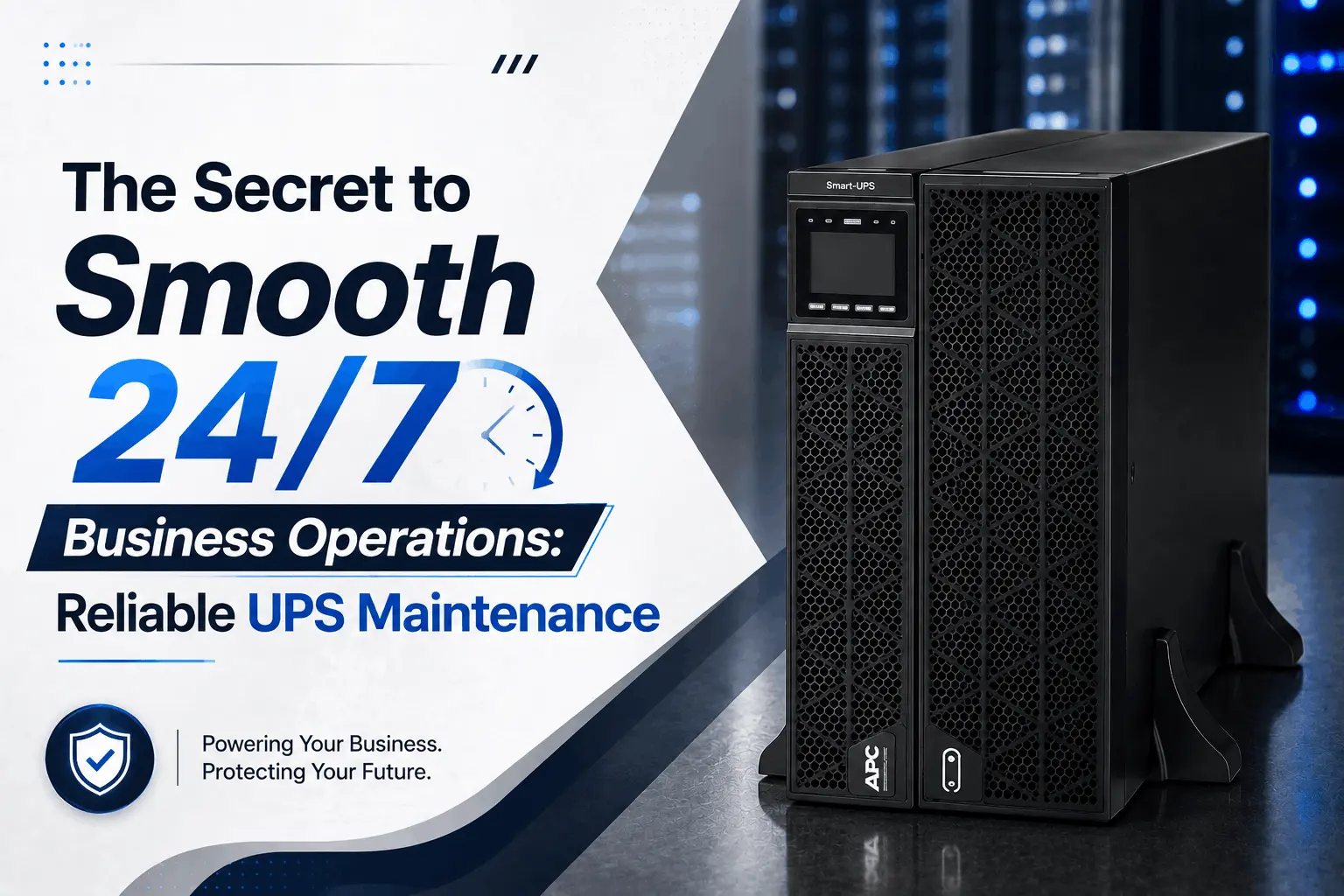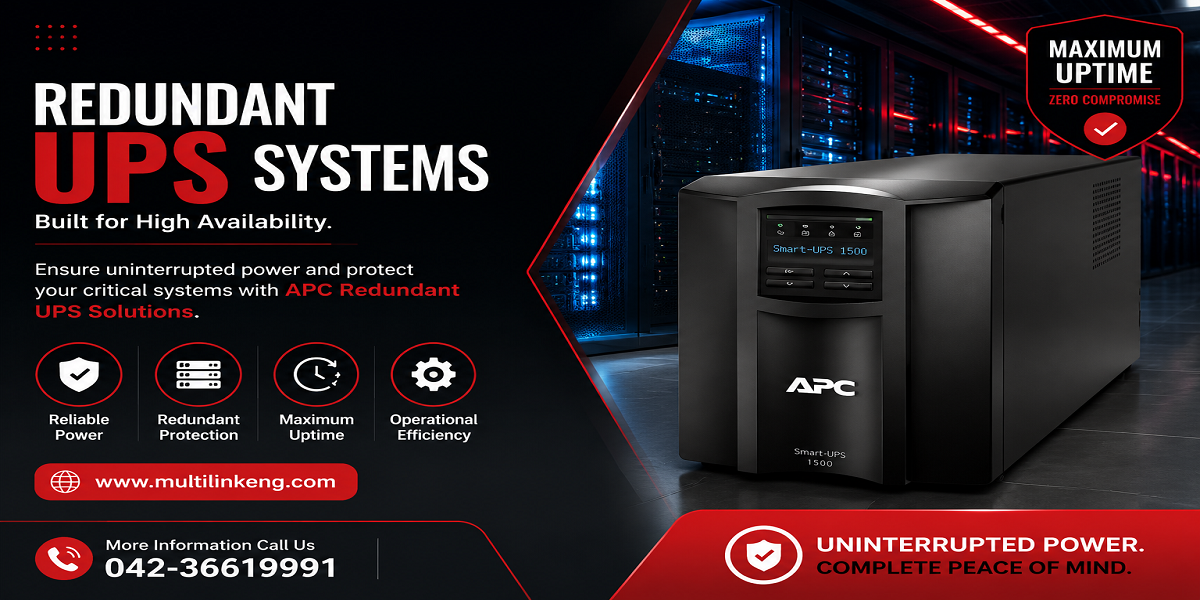
Modern data centers operate around the clock. Every second of downtime can cause financial loss, service disruption, and reputational damage. Therefore, businesses must build resilient power infrastructure. A redundant UPS system is one of the most important components of that strategy.
Organizations across Lahore, Karachi, and Islamabad are investing in advanced power protection. They understand that uninterrupted operations require more than a single UPS. Instead, they require intelligent redundancy using APC UPS systems.
Multilink Engineering (multilinkeng.com), an Elite APC Partner in Pakistan, delivers enterprise-grade APC UPS solutions for mission-critical environments. These solutions protect servers, storage systems, networking equipment, and cloud infrastructure from unexpected power failures.
What Is a Redundant UPS System?
A redundant UPS system uses multiple UPS units instead of relying on a single device. Consequently, if one UPS fails or requires maintenance, another UPS immediately supports the connected load.
This architecture eliminates single points of failure. As a result, businesses maintain continuous operations without service interruption.
Redundant UPS configurations commonly include:
- N+1 Redundancy
- N+N Redundancy
- 2N Redundancy
- 2N+1 Redundancy
Each design provides different availability levels based on business requirements.
Why High-Availability Data Centers Require UPS Redundancy
Data centers support cloud computing, financial systems, healthcare applications, manufacturing, telecom networks, and government services. Therefore, power interruptions are unacceptable.
Redundant UPS systems provide continuous power even during:
- Utility power failures
- UPS hardware failures
- Battery replacement
- Preventive maintenance
- Electrical disturbances
- Human error
- Unexpected equipment shutdowns
Consequently, organizations achieve higher uptime while reducing operational risks.
The Cost of Data Center Downtime
Downtime affects every department within an organization. Even a few minutes of power loss can interrupt critical operations.
Common consequences include:
- Lost business transactions
- Database corruption
- Server crashes
- Customer dissatisfaction
- SLA violations
- Reduced employee productivity
- Recovery expenses
- Brand reputation damage
Therefore, redundant APC UPS systems become an investment rather than an expense.
How APC UPS Redundancy Works
APC UPS solutions use intelligent power management technology. Multiple UPS units share the electrical load under normal conditions.
If one UPS develops a fault, the remaining UPS modules instantly support the load. Therefore, connected equipment continues operating without interruption.
Advanced APC UPS systems also include:
- Intelligent battery monitoring
- Hot-swappable modules
- Automatic self-testing
- Parallel redundancy
- Remote monitoring
- Predictive maintenance
- Load balancing
- Network management integration
These capabilities improve reliability while simplifying maintenance.
Understanding N+1 UPS Redundancy
N represents the minimum UPS capacity required.
The additional “+1” UPS provides backup capacity.
For example:
If a data center requires four UPS modules, installing five creates N+1 redundancy.
Benefits include:
- Higher system availability
- Reduced maintenance risk
- Improved fault tolerance
- Better scalability
- Lower operational disruption
Therefore, N+1 has become the industry standard for many enterprise environments.
2N Redundancy for Maximum Availability
Organizations with zero downtime requirements often deploy 2N redundancy.
This architecture uses two completely independent UPS systems.
Each UPS can support the entire critical load independently.
Advantages include:
- No single point of failure
- Maximum fault isolation
- Independent power paths
- Simplified maintenance
- Exceptional uptime
Consequently, banks, telecom operators, hospitals, and hyperscale data centers frequently choose 2N designs.
Key Features of APC UPS Systems
APC UPS solutions remain the preferred choice for enterprise data centers worldwide.
Key features include:
High Power Efficiency
Modern APC UPS systems achieve excellent energy efficiency. Therefore, businesses reduce electricity costs without sacrificing protection.
Scalable Architecture
Organizations can increase capacity as infrastructure grows. Consequently, future expansion becomes simple.
Advanced Battery Management
Intelligent battery monitoring extends battery life while improving reliability.
Hot-Swappable Components
Technicians replace batteries and power modules without shutting down connected equipment.
Intelligent Network Monitoring
Remote monitoring allows administrators to detect issues before failures occur.
Benefits of Redundant APC UPS Systems
Maximum Business Continuity
Critical applications remain online even during equipment failures.
Reduced Downtime
Automatic failover prevents unexpected shutdowns.
Simplified Maintenance
Engineers perform maintenance without interrupting operations.
Better Disaster Recovery
Power redundancy strengthens overall disaster recovery planning.
Higher Return on Investment
Although redundancy increases initial investment, it significantly reduces costly outages.
Why APC UPS Is Ideal for Pakistan’s Data Centers
Pakistan’s electrical infrastructure experiences voltage fluctuations, outages, and unstable utility conditions.
Therefore, organizations require enterprise-grade UPS systems.
Businesses in Lahore, Karachi, and Islamabad increasingly depend on APC UPS solutions because they provide:
- Reliable power protection
- Fast response during outages
- Long battery life
- Intelligent monitoring
- Modular expansion
- Proven enterprise reliability
Consequently, APC has become one of the most trusted UPS brands for mission-critical applications.
Industries That Need Redundant UPS Systems
Several industries cannot tolerate downtime.
These include:
- Financial institutions
- Government organizations
- Hospitals
- Cloud service providers
- Telecom companies
- Manufacturing plants
- Universities
- Software houses
- Enterprise IT facilities
- Colocation data centers
Each sector depends on uninterrupted power for continuous operations.
Best Practices for Designing a Redundant UPS Infrastructure
Organizations should follow proven design principles.
These include:
- Perform detailed load analysis.
- Design for future expansion.
- Separate critical and non-critical loads.
- Use intelligent battery monitoring.
- Schedule preventive maintenance.
- Test backup systems regularly.
- Install environmental monitoring.
- Implement dual power paths.
- Monitor power quality continuously.
These practices improve long-term system reliability.
Importance of Professional UPS Installation
UPS redundancy depends on correct system design.
Improper installation can eliminate redundancy benefits.
Professional engineers ensure:
- Accurate sizing
- Proper cable management
- Load balancing
- Battery optimization
- Parallel configuration
- Safety compliance
- Performance testing
- Documentation
Therefore, organizations should work with experienced APC specialists.
Why Choose Multilink Engineering for APC UPS Solutions
Multilink Engineering is an Elite APC Partner in Pakistan. The company delivers complete power protection solutions for enterprise customers.
Its services include:
- APC UPS consultation
- UPS sizing and design
- Data center power assessment
- Professional installation
- Commissioning
- Preventive maintenance
- Battery replacement
- Annual maintenance contracts
- Emergency support
- Remote monitoring solutions
Organizations across Lahore, Karachi, and Islamabad trust Multilink Engineering because of its technical expertise, certified engineers, and commitment to delivering reliable APC UPS infrastructure.
Whether you are building a new data center or upgrading an existing facility, Multilink Engineering provides scalable APC UPS solutions that maximize uptime and protect mission-critical operations.
Frequently Asked Questions (FAQs)
1. What is UPS redundancy in a data center?
UPS redundancy uses multiple UPS systems to ensure uninterrupted power if one UPS fails or undergoes maintenance.
2. Which UPS redundancy configuration is best?
The best configuration depends on business requirements. N+1 suits most enterprises, while 2N provides the highest availability for mission-critical facilities.
3. Why is APC UPS recommended for enterprise data centers?
APC UPS systems offer high efficiency, modular scalability, intelligent battery management, remote monitoring, and proven reliability for critical applications.
4. Does Multilink Engineering provide APC UPS installation in Pakistan?
Yes. Multilink Engineering is an Elite APC Partner in Pakistan and provides APC UPS consultation, installation, commissioning, maintenance, and support across Lahore, Karachi, Islamabad, and other major cities.
5. How often should redundant UPS systems be maintained?
Enterprise UPS systems should undergo preventive maintenance at least twice a year. Regular battery testing, firmware updates, and system inspections help ensure maximum reliability and continuous uptime.